The world of sensors -
In control with Pierburg
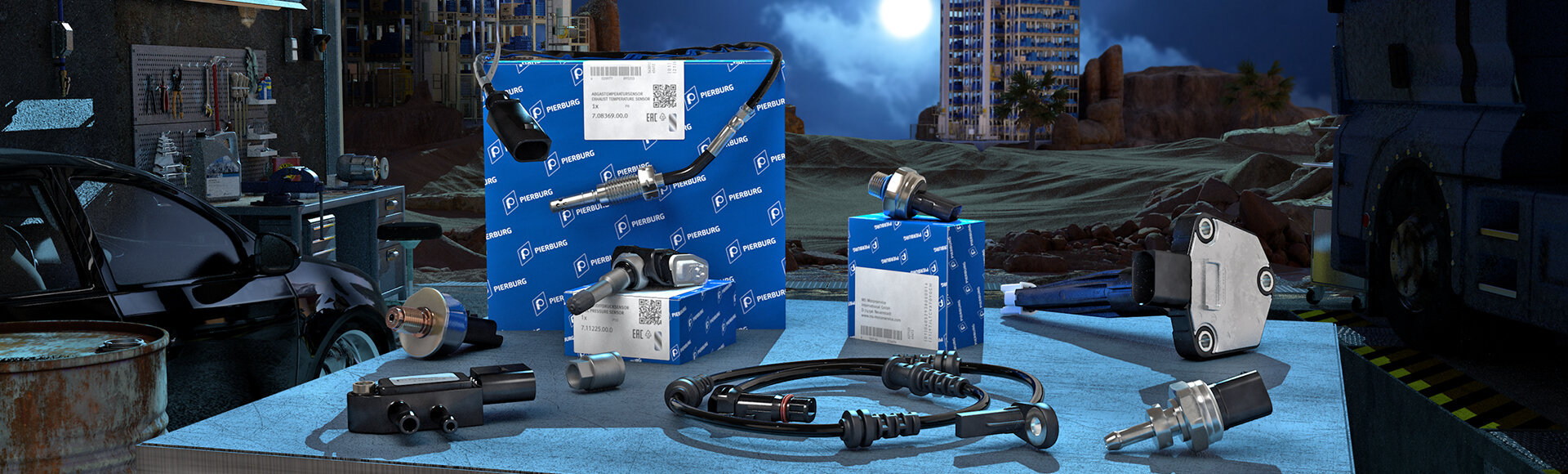
Sensors from Pierburg - A tailor-made offer with wide market coverage
Our sensors in OE quality have proven themselves millions of times over across the globe. They are indispensable components, and several of them can often be found installed in one vehicle. That is why we keep on expanding our product range.
We need your consent to load the YouTube service!
In order to play YouTube videos, a connection to YouTube must be established. This will also entail data processing and cookie usage by YouTube/Google (possibly also out of the USA). By clicking "Accept", you consent to this data processing and the placing of YouTube cookies on your terminal device. Your selection will be saved for future visits to this website. You may find further information under "More" and in our Data Protection Information.
Product portfolio
Download
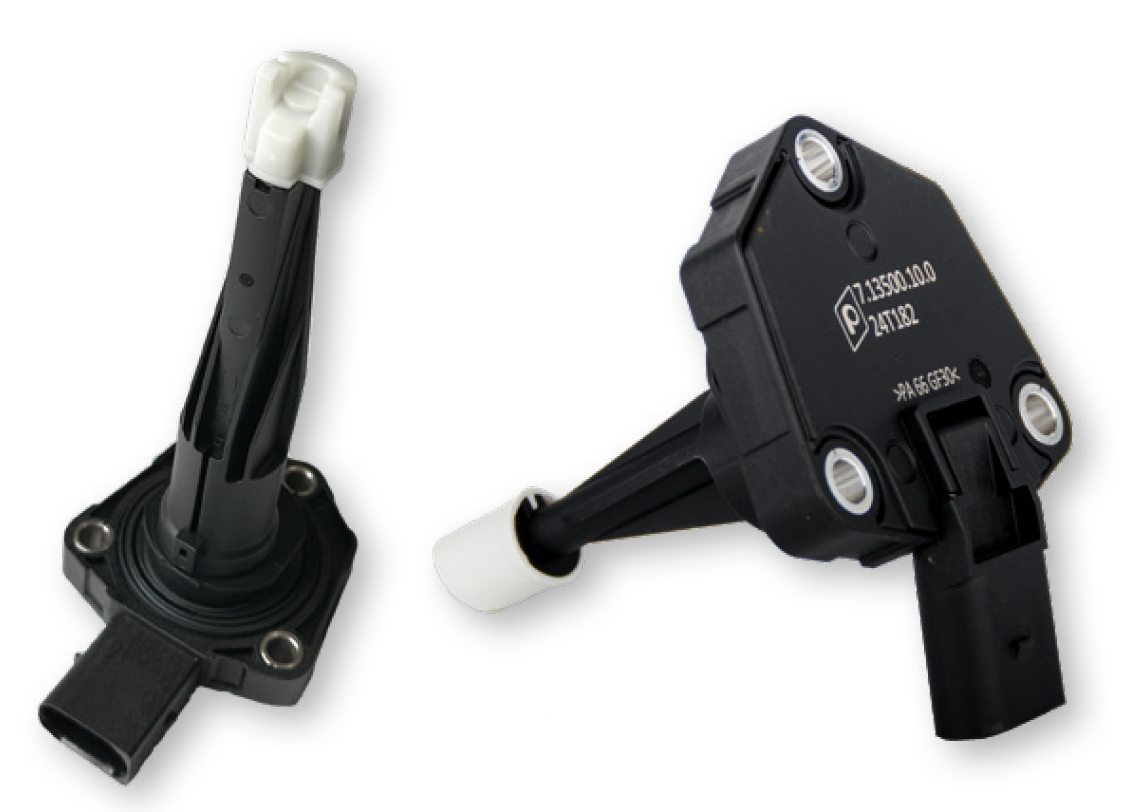
Oil level sensors
The oil level sensor records the amount of oil in the engine – depending on the operating state – and is a central component of the engine management system. Nowadays, the sensor is often mounted on the bottom of the oil pan and measures theoil level. Depending on the version, the sensor also detects the temperature and the engine oil grade. This information is sent to the control unit.
Oil level sensors are available in three categories: float, ultrasound and heat. Motorservice offers the ultrasonic type of oil level sensors.
The ultrasonic sensor is mounted in the oil pan from below and emits ultrasonic waves in the oil. These are reflected by the surface of the oil (air / oil surface). The sensor measures the time from the transmission of the ultrasonic wave to the arrival of the reflected ultrasonic wave. In this way, the fill level can be measured and output precisely. To prevent errors, an average is calculated from
several measurements. In addition, the engine control unit detects special situations, such as engine start. The ultrasonic sensors also detect the temperature via another measuring element. This also has an influence on the measurement. Special advantages of the sensor are short response times and high accuracy.
The oil level sensors are currently available for a worldwide fleet of more than 93 million passenger cars.
YouTube Short Video: How the oil level sensor works
Oil pressure sensors
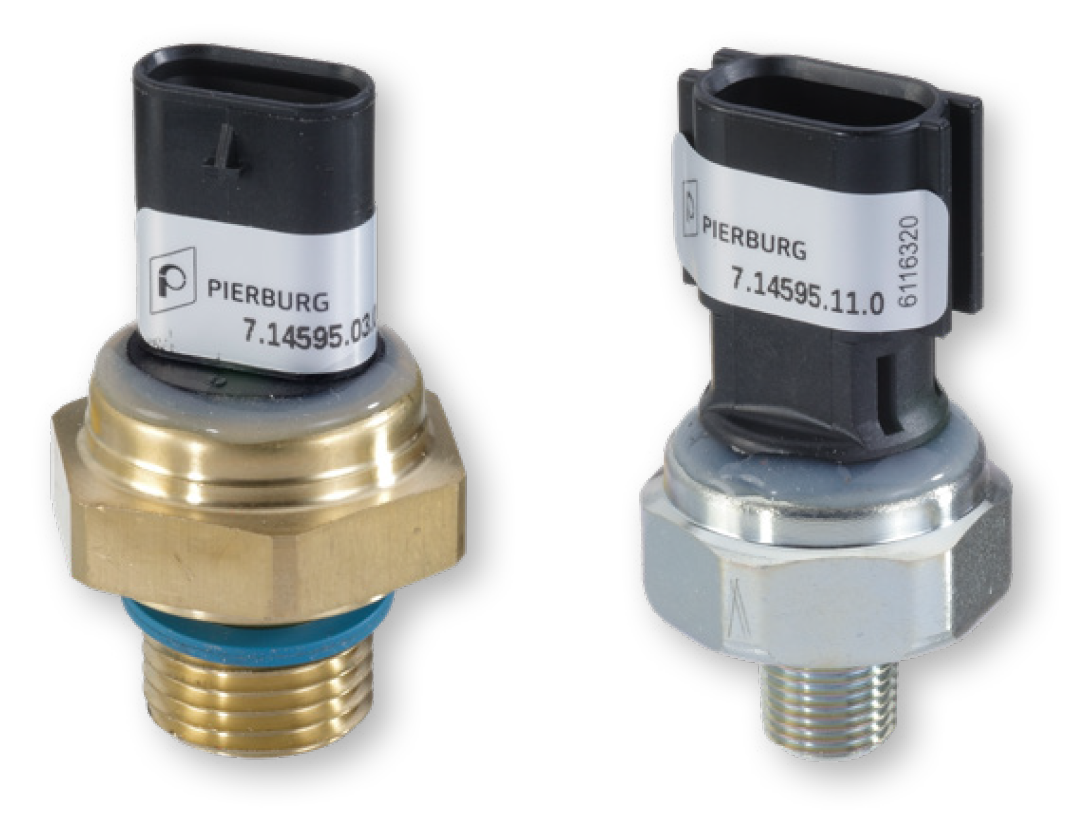
The oil pressure sensor continuously measures the oil pressure in the engine and sends the information to the engine control unit. The sensor thereby ensures a sufficient oil supply and prevents consequential damage. Modern vehicles also use the data from the oil pressure sensor for optimum engine performance and optimised fuel consumption. Unlike oil pressure switches, which only trigger an alarm when the oil pressure falls below a certain value, oil pressure sensors provide precise values.
If the oil pressure sensor is triggered when the oil pressure is too low, this can, for instance, indicate oil loss, but may also be the result of a defective oil pump or other defects. A piezoresistive cell measures the engine oil pressure. The piezoresistive effect is based on the change in electrical resistance in a material under pressure (or tension). An expansion measuring device can be used for this purpose. Alternatively, capacitive sensor elements are used to measure the pressure. The sensor processes this information and sends the pressure values to the engine control unit via a PWM (pulse width modulation) signal.
With these oil pressure sensors, Motorservice covers over 38 million passenger cars and commercial vehicles.
Nitrogen oxide / NOx sensors
With nitrogen oxide or NOx sensors, Motorservice is enlarging its product range in the field of exhaust gas sensor systems from Pierburg.
The available item numbers cover a global vehicle fleet of more than 13 million vehicles, including utility vehicles from the “big seven” – DAF, Iveco, MAN, Mercedes-Benz, Renault, Scania and Volvo.
These sensors are a key component for reducing harmful nitrogen oxides, NOx for short.

Sensors for the tyre pressure monitoring system (TPMS)
The sensors are available in versions as clamp-in sensors with cap nut and as snap-in sensors with rubber coating. These are active sensors (433 MHz) in the direct TPMS.
The 30 articles cover approx. 222 million vehicles worldwide.

Wheel speed sensors
Wheel speed sensors are among the most important sensors in a vehicle. Their signal serves as an input variable for safety and comfort systems, such as the anti-lock braking system (ABS), electronic stability control (ESC), traction control system (TCS) or in the tyre pressure monitoring system. In this way, they make a direct contribution to driving safety, driving comfort and fuel consumption.
The 35 articles cover approx. 270 million vehicles worldwide.

Exhaust gas temperature sensors
Exhaust gas temperature sensors monitor the hot exhaust gas flow and protect components from overheating.
Typical applications include protecting components which are sensitive to temperature, such as turbochargers and all forms of catalytic converters, monitoring the free-burning process of the diesel particulate filter, controlling the optimal temperature range for catalytic converters and measuring the EGR exhaust gas temperature as part of on-board diagnostics (OBD). In the event of critical overheating, the control unit responds by taking appropriate action to reduce the temperature, e.g. through reduced performance (limp home function).
Motorservice offers more than 250 exhaust gas temperature sensors covering more than 155 million vehicles.
Exhaust gas pressure sensors
In addition to lambda sensors and exhaust gas temperature sensors, exhaust gas pressure sensors are the third product group of exhaust gas sensors available from Pierburg.
This group includes the following types of sensor:
- Differential pressure sensors are mainly used to determine how soiled the particulate filter is. They can also be used to detect whether e.g. an air filter or an EGR cooler is clogged or blocked.
- Exhaust back pressure sensors protect the engine and turbocharger against excess pressure.
Motorservice’s current range of exhaust gas pressure sensors and differential pressure sensors covers roughly 160 million vehicles worldwide.
Fuel pressure sensors
Also referred to as fuel rail pressure sensors, these components supplement Pierburg’s existing range of fuel supply and sensor products.
In many cases, the rail can only be purchased as a complete unit along with all the attachments. However, Motorservice offers the pressure sensor separately as a spare part.
The item numbers that are currently available are compatible with a huge number of vehicles globally — over 140 million. The range is continually being expanded.
Lambda sensors
Lambda sensors measure the residual oxygen in the exhaust gas. This produces a lambda value, which the engine management system uses to regulate the mixture composition for the most optimal combustion possible.
Lambda sensors are the most important element in engine management systems in terms of ensuring perfect engine running with low emissions.
High operating temperatures and aggressive exhaust gas place high demands on lambda sensors. You should therefore choose products from the specialist for emission control.
Offering over 120 different lambda sensors, Motorservice covers the needs of more than 266 million vehicles worldwide.
Air mass sensors
Air mass sensors have been used in almost every vehicle for the last decade, and have become one of the most important components in engine management. They are therefore a key component in the air supply system and for emission control.
The air mass sensor records the air mass flowing into the engine. Its signal is used to calculate the injected fuel quantity, and in diesel engines also for regulating the exhaust gas recirculation.
Motorservice offers Pierburg air mass sensors with a flow pipe or as a separate plug-in probe, suitable for over 290 million vehicles.
Air pressure sensors
Air pressure sensors supply important input variable for the engine control
system. The commonly used abbreviation “MAP sensors” stands for “manifold absolute pressure”.
With around 60 OE references, these air pressure sensors cater for almost 1100 applications in Audi, VW, Škoda, Seat, Opel, Vauxhall, Fiat and PSA vehicles.
This corresponds to more than 170 million vehicles worldwide.
Pierburg sensors are used in a diverse range of systems for all aspects related to the engine.